A new study using CUREO provides robust evidence that virtual reality–based therapy can effectively support Parkinson's rehabilitation. In particular, maintaining and improving mobility of the upper extremities plays a central role. Limitations in arm and hand function affect numerous activities of daily living from grasping and writing to communication and have a direct impact on independence and quality of life. Regular, motivating, and evidence-based therapy is therefore essential to stabilize or specifically improve motor abilities in people with Parkinson’s disease.

Parkinson’s disease is a neurodegenerative disorder of the brain in which dopamine-producing nerve cells progressively degenerate. Dopamine is a key neurotransmitter responsible for the control of coordinated movements. Its gradual deficiency leads, among other symptoms, to bradykinesia (slowness of movement), muscle rigidity, and tremor.
In addition to gait impairments, the upper extremities are particularly often affected. Limitations in arm and hand function make everyday activities such as grasping, writing, dressing, or eating more difficult, thereby directly reducing patients’ independence and quality of life.
With CUREO, CUREOSITY has developed a virtual reality–based therapy that combines movement, motivation, and modern neurotraining. The effectiveness of this approach has now been demonstrated for the first time in a blinded, randomized controlled trial, the results of which were published on January 8, 2026, in the renowned Journal ofNeuroEngineering and Rehabilitation. This proof of efficacy according to the scientific gold standard marks an important milestone for digital rehabilitation and the scientific evidence base of modern VR therapy approaches.
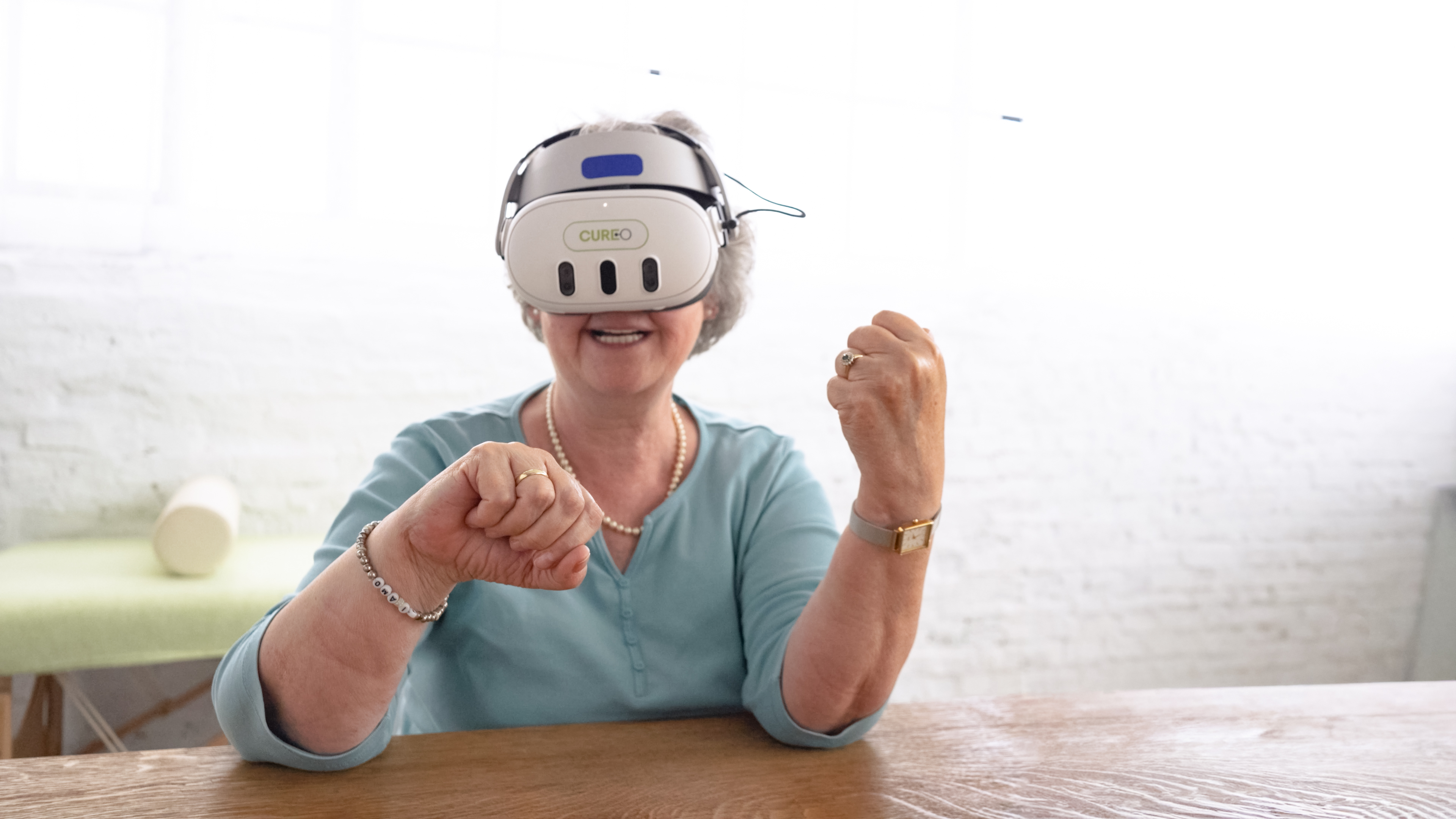
The randomized controlled trial (RCT) was conducted by the REHA Center Münster in Tyrol and the Klinikum Bad Hall in Austria. Scientific leadership was provided by the Department of Rehabilitation Research at REHA Center Münster, under the direction of Dr. Barbara Seebacher.
The close integration of clinical practice and scientific research ensured that the study was both methodologically rigorous and highly relevant to real-world clinical settings.
A total of 58 patients with Parkinson’s disease participated in the study. They were randomly assigned to two groups. One group received virtual reality–based therapy with CUREO, while the other group underwent conventional upper-limb therapy.
Both groups trained for four weeks, with four sessions per week, each lasting 30 minutes.
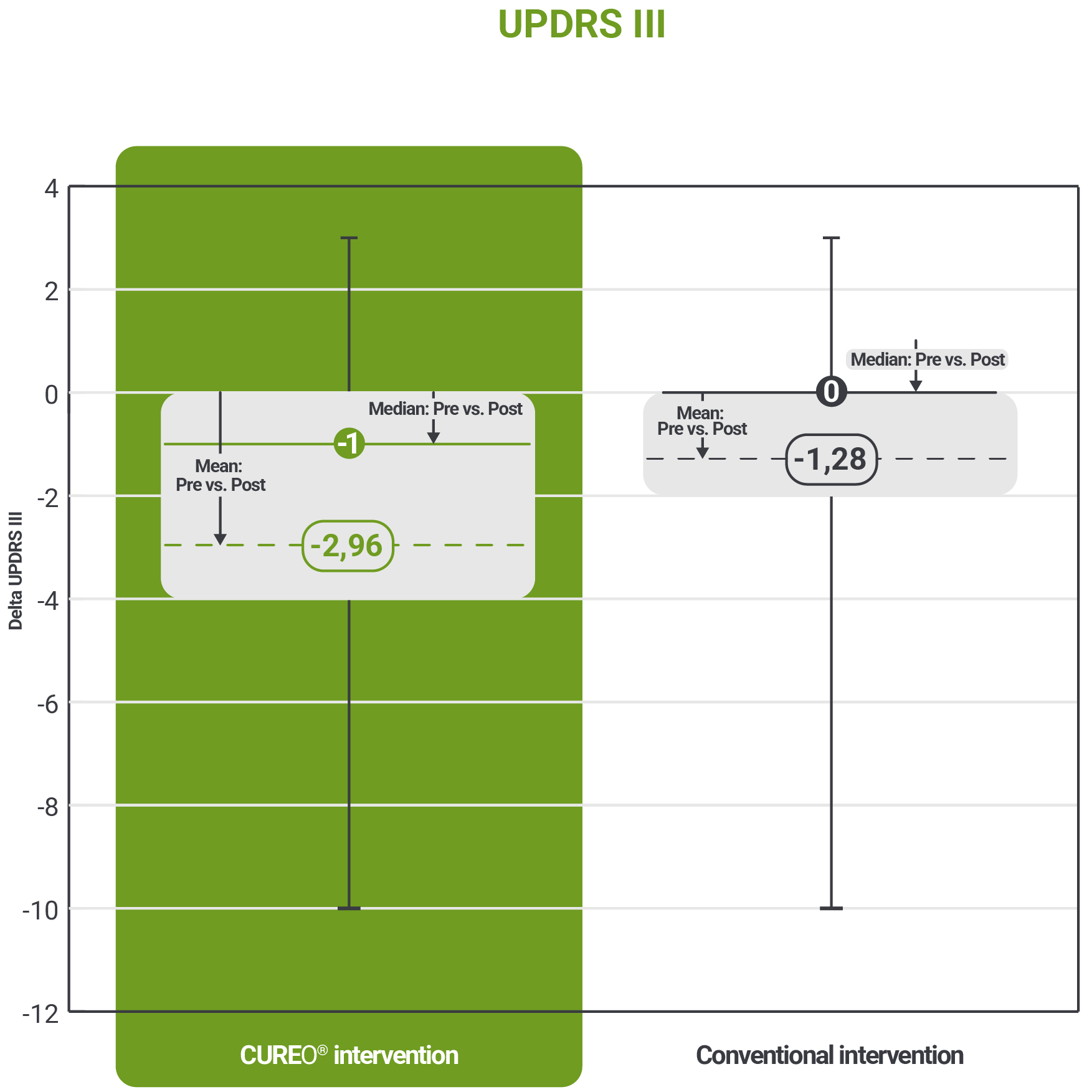
1. Both the VR-based therapy and the conventional therapy led to comparable, significant improvements in arm and hand function. Compared with conventional therapy, CUREO showed significantly greater improvements in motor function (UPDRS III).
2. CUREO also demonstrated significant improvements in three patient-reported outcomes (PROs according to the PDQ-39):
- activities of daily living (ADL),
- cognition, and
- emotional well-being (EWB).
In contrast, conventional therapy achieved improvements in two PROs: stigma and EWB. Figure 2 presents the PRO results displayed as medians.
.png)
The results clearly show that both therapy approaches are effective and can complement each other meaningfully in Parkinson rehabilitation. CUREO offers a modern, motivating, and effective training option for people with Parkinson’s disease, scientifically confirmed by a randomized controlled trial. VR therapy thus opens up new opportunities for clinics, rehabilitation centers, and therapeutic facilities to specifically train motor functions while increasing both patient motivation and therapy intensity.
Link to the publication: https://link.springer.com/article/10.1186/s12984-025-01851-1